
Architectural considerations
There are several factors to consider when selecting hardware for building a Ceph storage cluster. Canonical Ceph cluster design choices are influenced by infrastructure node requirements (which are influenced by method of deployment), cluster service placement approach, the purpose of the cluster, and various hardware and software specifications, e.g. Random Access Memory (RAM), operating system (OS), network, disks, server requirements, etc.
Infrastructure node requirements
Management infrastructure requirements vary by deployment option. The Juju-based options, i.e., Charmed Ceph and charm-microceph, require a Juju controller environment, typically deployed alongside Metal as a Service (MAAS) for bare-metal provisioning. Canonical recommends dedicating three infrastructure nodes to host Juju and MAAS in a High Availability (HA) configuration. Ceph Rocks and stand-alone MicroCeph options have no such dependency; you bring your own orchestration or manage nodes directly.
Regardless of deployment option, production environments benefit from additional management infrastructure for observability, and fleet management/patching. For observability, we recommend the Canonical Observability Stack (COS), and for management/patching, we recommend using Landscape. These typically require another three-node cluster, which can be colocated with the Juju/MAAS infrastructure nodes where applicable, reducing the total infrastructure footprint.
Cluster service placement
Ceph is composed of several components, both for the control plane and the data plane. Control plane services include Ceph Monitors (MONs), Ceph Managers (MGRs), and Ceph metadata servers (MDSs), whereas the data-plane services include Ceph object storage daemons (OSDs), Ceph RADOS Gateway (RGW), and the Ceph Filesystem (CephFS).
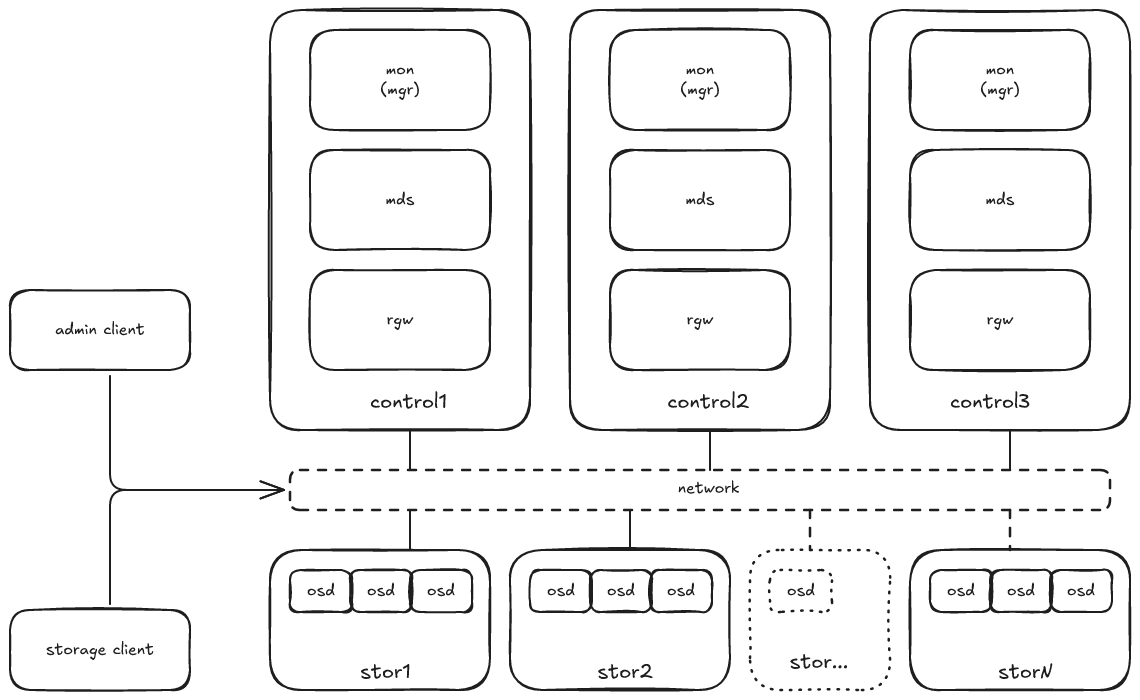
Canonical recommends the hyperconverged and disaggregated approaches to service placement in the Ceph cluster, depending on your use case. In general, we recommend minimising the number of hardware configurations to simplify capacity planning and replacement strategy.
Hyperconverged architecture
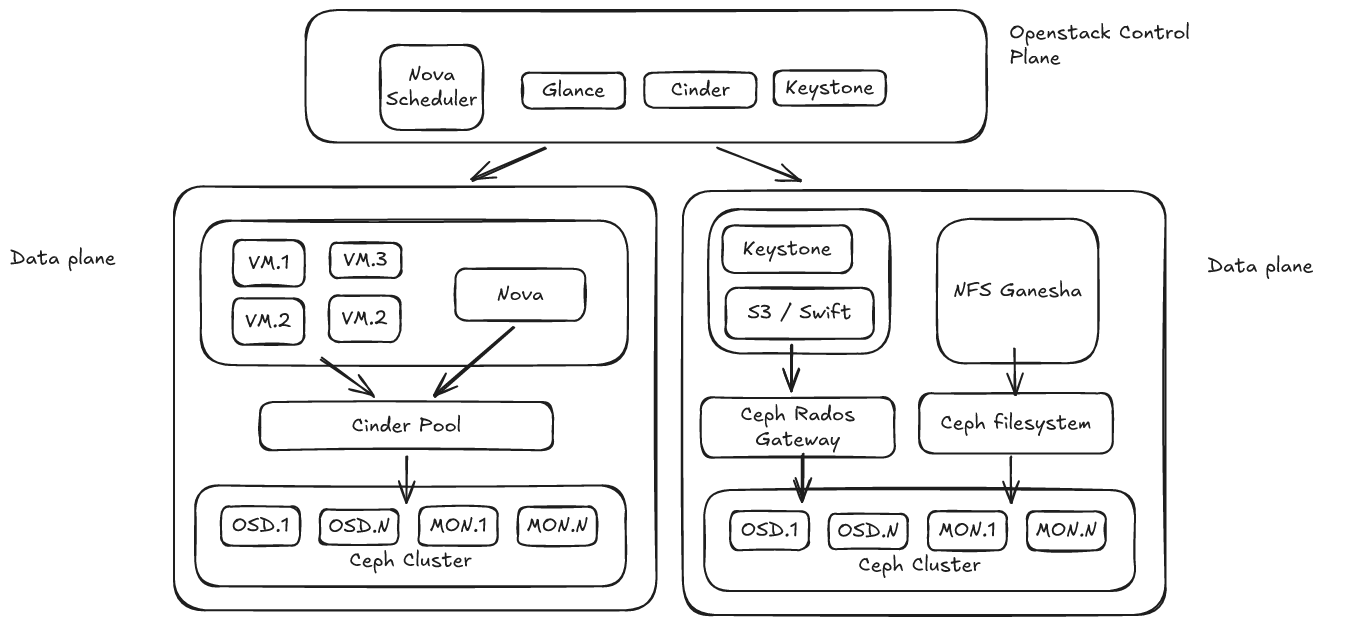
The hyperconverged approach to cluster placement is characterised by a setup where every node in the cloud is hosting the control plane services.
The hyperconverged architecture enables standardisation on a single hardware configuration, ensures maximum resource utilisation and minimises the overall number of nodes. Therefore, it has proven to provide the lowest private infrastructure total cost of ownership (TCO).
The hyperconverged architecture is suitable for general-purpose storage, but it may not be a suitable option for specific workloads and certain storage use cases.
The diagram below is a representation of a hyperconverged architecture setup in the context of an OpenStack deployment.
Disaggregated architecture
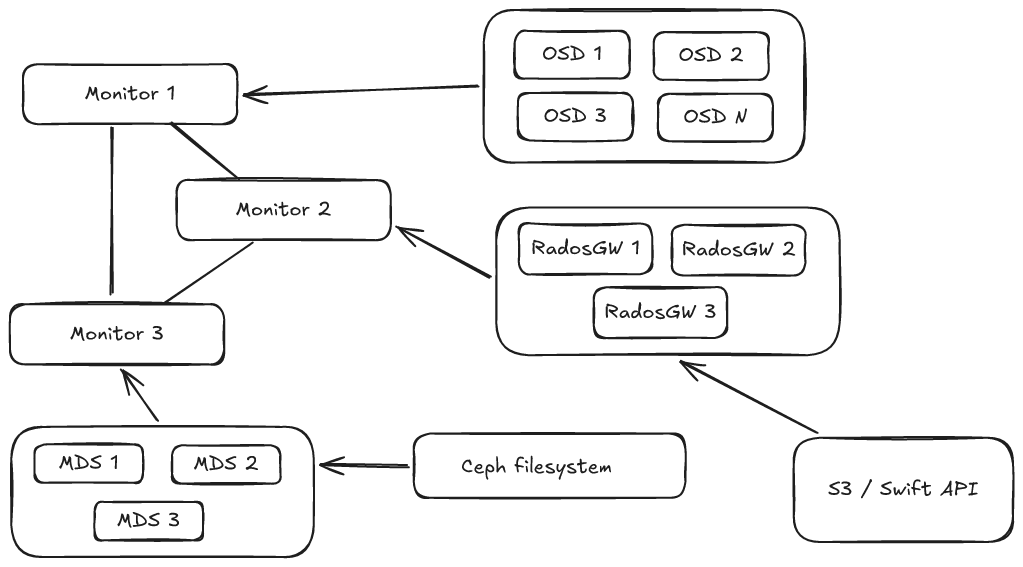
The disaggregated approach, on the other hand, features dedicated nodes for each type of service.
This architecture is suitable in specific scenarios, for example, where applications require high performance object or file system storage, because dedicated RGWs or MDSs can provide lower latency and higher bandwidth by allocating dedicated resources to those services.
Purpose of the storage cluster
The next aspect to consider when selecting hardware for a Ceph cluster is the purpose of the storage environment, which may be one of the following:
Performance
Capacity
General-purpose storage
A high performance cluster will look differently from a general-purpose or large capacity cluster.
The type of storage needed will also impact the overall design. For example, a high-performance object storage cluster will perform better if it is not mixed with RBD (block storage) and CephFS (file system storage) storage pools. Empty storage pools can unbalance the distribution of the storage on the cluster and lead to performance issues. For this reason, we will consider three scenarios throughout the reference architecture:
Balanced use case; with block, object and file system storage available
Object storage only (RGW)
File system storage only (CephFS)