
MicroCeph architecture
MicroCeph packages core Ceph daemons (MON, MGR, OSD, and optionally RGW, MDS) into a single snap. These daemons are managed by the microcephd service, which uses a distributed dqlite database for configuration and state. Management is primarily done via the microceph command-line tool interacting with microcephd, alongside standard snapd services.
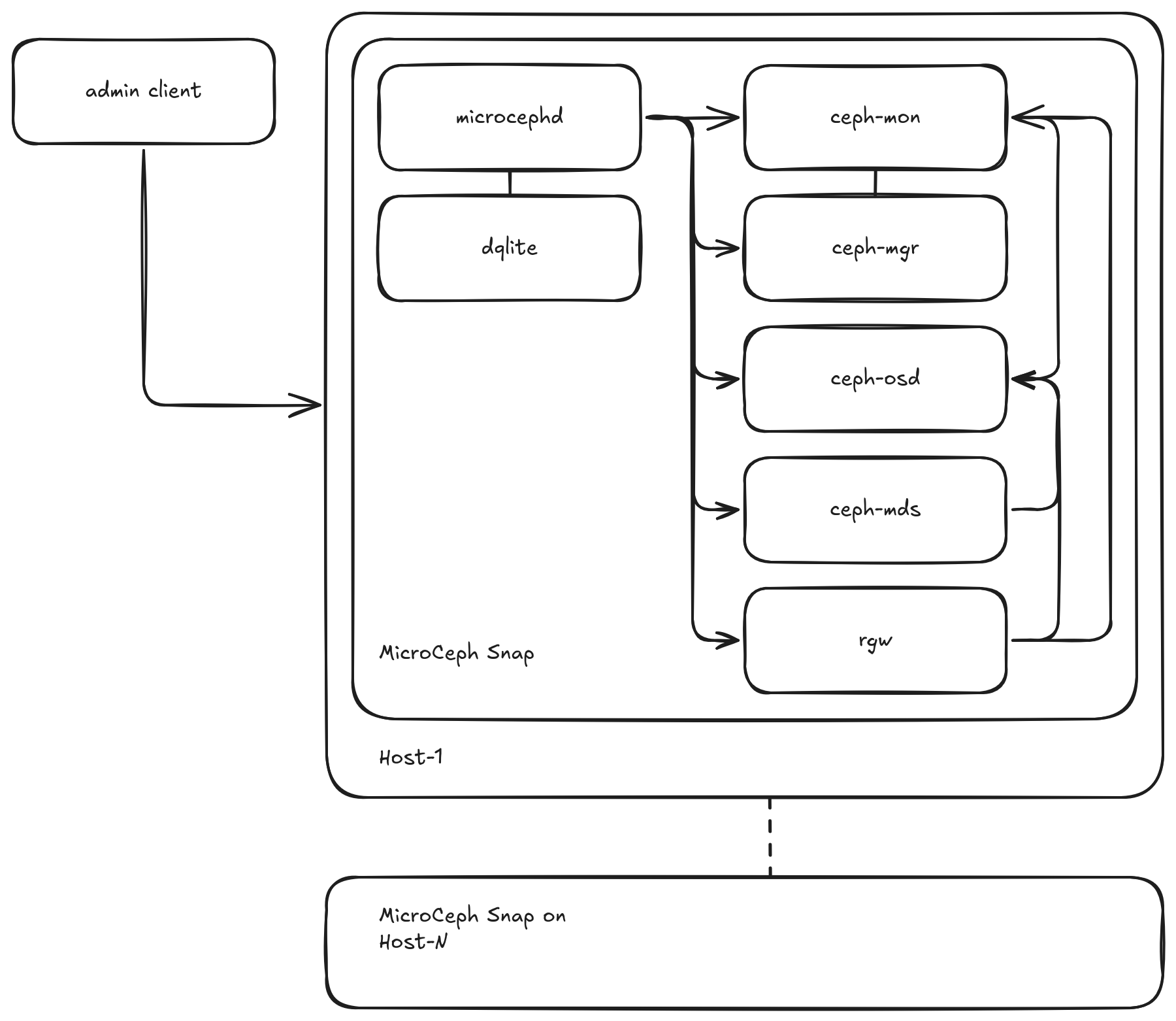
MicroCeph Architecture Overview
Components
Host System: The underlying Linux operating system where the MicroCeph snap is installed.
MicroCeph Snap: The package containing Ceph daemons, microcephd, and management logic. It runs with confinement provided by snapd. See the snap security confinement documentation to learn more about snap security and isolation.
microcephd: The core service (based on Microcluster) responsible for managing the MicroCeph cluster state, coordinating actions across nodes (if clustered), and managing the Ceph daemons within the snap.
dqlite Database: A distributed SQLite database used by microcephd to store cluster configuration, node status, and other metadata.
microceph CLI: The primary tool used by administrators to interact with microcephd for managing MicroCeph instances.
Ceph Daemons (within the snap):
ceph-mon: Ceph Monitor (MON) daemon(s), maintaining cluster state and consensus.
ceph-mgr: Ceph Manager (MGR) daemon(s), providing access to management APIs and modules like the Dashboard.
ceph-osd: Ceph object storage daemons (OSDs), managing data on underlying storage devices.
ceph-radosgw (optional): Ceph Object Gateway (RGW) service, providing S3/Swift-compatible object storage.
ceph-mds (optional): Metadata Server (MDS) daemons for CephFS.
Client Workloads: Consume Ceph storage via RBD block devices, RGW object buckets, or CephFS shared filesystems.